How to look at an abstract acrylic painting
An abstract painting has no subject to recognise, so many people glance at it and move on. Looking well is a skill you can practise. These steps use four drip-style acrylic paintings from this site as examples.
Start from across the room
Stand far enough away that the whole canvas fits easily in your view. At this distance you cannot read detail, so you notice the overall balance: is one area heavier, darker or busier than another? Does the colour lean warm or cool? Give it a full minute before you step closer.
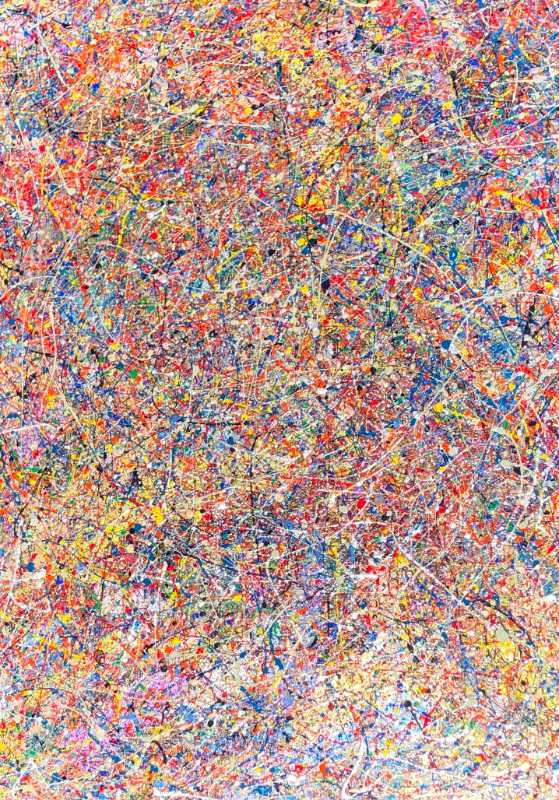
In Cosmos, the far view reads almost as one warm, speckled texture. No single spot pulls your eye. Painters call this an all-over composition: the activity spreads evenly to every edge.
Follow one colour
Pick a single colour and trace it across the surface. Ask where it sits: on top of other paint, or underneath it? This tells you the order the artist worked in, because later layers cover earlier ones.
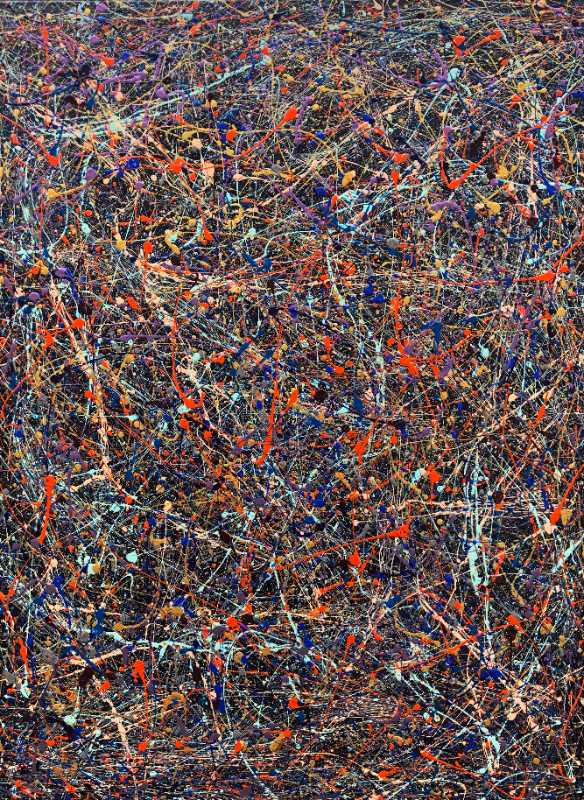
In Midnight, follow the orange-red. It cuts across the dark ground in short bright strokes and stands forward because of the contrast. The pale blue lines feel thinner and further back even though they lie on the same flat surface.
Look at the line
With poured and dripped paint, each line records a movement. Thick blobs show where paint landed slowly or pooled. Long thin threads show a fast sweep of the arm. Curves and loops suggest a circling motion; straight runs suggest a quick pass. Try to read the gesture behind a few lines, as if you were watching the painting being made.
Notice the format
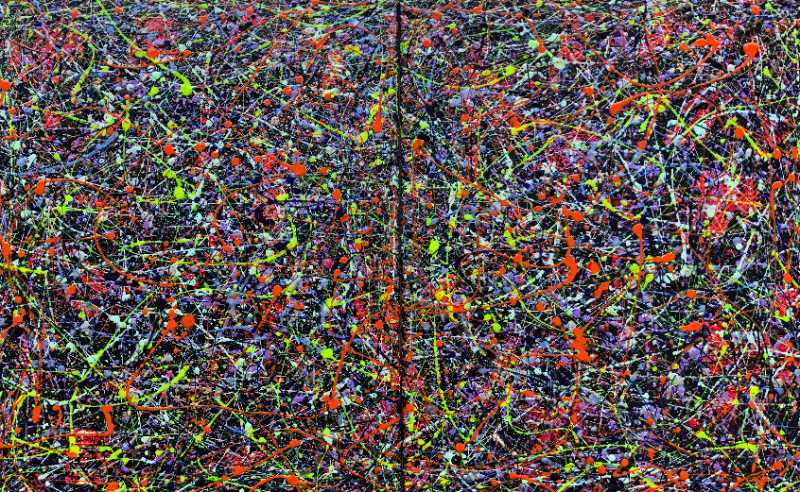
A wide canvas invites the eye to travel side to side; a tall one pulls it up and down. In the image of Whacked, a thin dark vertical line splits the field, and the eye starts comparing left and right halves. Ask whether the two sides feel balanced or whether one side carries more weight.
Step in close
Now move near enough to see texture. Raised drips catch light; flat areas do not. You may see small cells where colours mixed wet, or crisp edges where a new layer landed on dry paint. Close up, an all-over painting often stops looking random and starts to show rhythm and repeated marks.
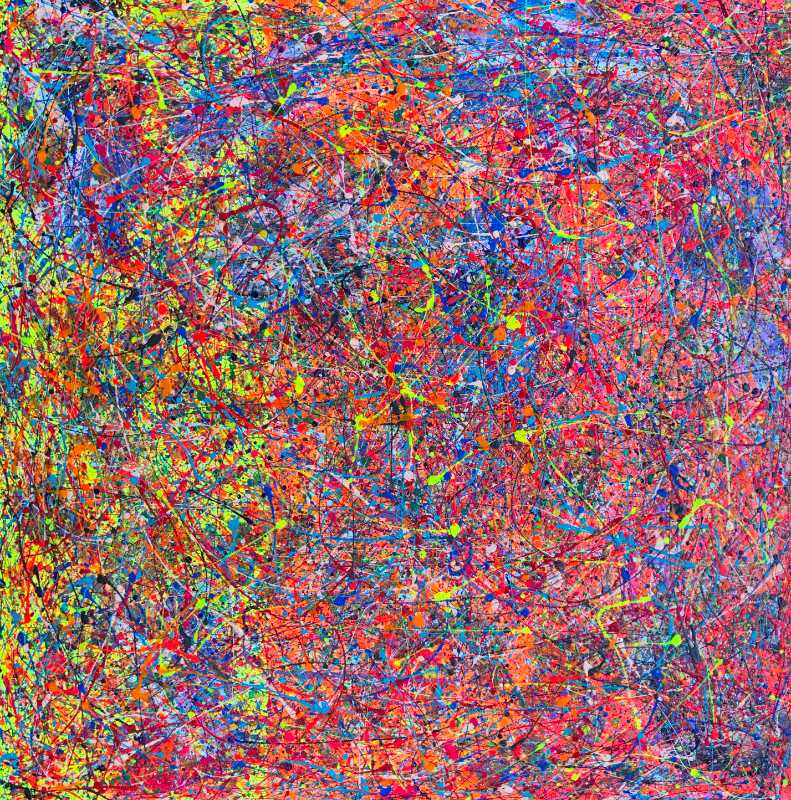
A title like Mozart Symphony offers one route in: you can look for rhythm, repetition and crescendo, much as you would listen for them. Treat a title as a hint, not an instruction.
A five-question checklist
- What do I notice first from far away?
- Which colour is on top, and which is buried?
- What kind of movement made these lines?
- How does the shape of the canvas steer my eye?
- What changes when I step close?
Common mistakes
- Judging from a phone thumbnail. Texture and scale vanish on a small screen.
- Hunting for a hidden picture instead of looking at what is there.
- Deciding in five seconds. Most abstract work rewards a few minutes.
Questions
Is there a right way to interpret an abstract painting?
No single reading is correct. Describing what you see first, then what it makes you feel, is a sound method.
Why do photos of these paintings look different from the real thing?
Cameras flatten texture and shift colour. Raised paint and gloss only show fully in person under good light.